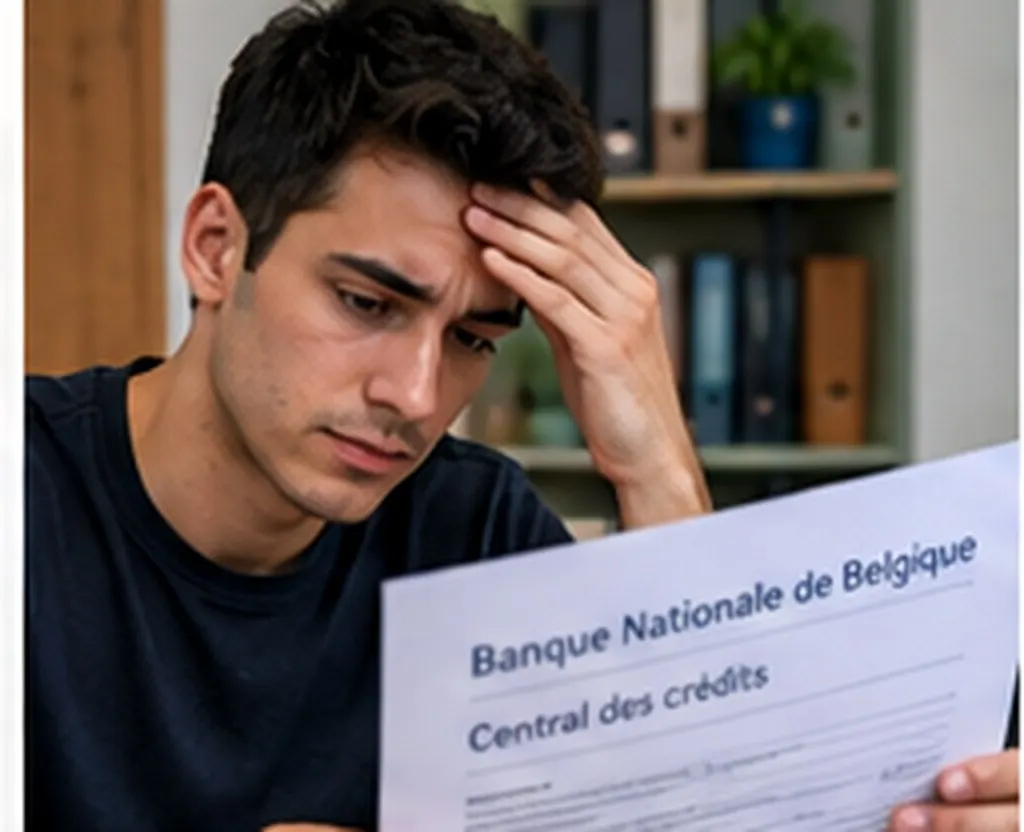
What the BNB credit register is
Student credit with BNB registration refers to borrowing as a student who appears in Belgium's central credit register, a situation that shapes which lenders will accept the file and which routes remain open. The Central Individual Credit Register (Centrale des Crédits aux Particuliers, Centrale voor Kredieten aan Particulieren) is kept by the National Bank of Belgium. It records every consumer credit and mortgage contract taken out by individuals in Belgium, whether or not it is repaid on time. That positive part of the file includes personal loans, instalment sales, credit cards with a credit line and authorised overdrafts above the legal threshold.
The register also has a negative part. When a borrower falls behind beyond the thresholds set by law, the lender must report the default. A collective debt settlement (règlement collectif de dettes) ordered by a court is recorded as well. People often call this negative entry "being on the BNB list" or a "fiche BNB".
Lenders are legally required to consult the register before granting or increasing a credit. A student with an active default cannot therefore hide it, and an application for student credit with BNB registration will appear to the lender exactly as it is.
How a student ends up with a BNB registration
Students rarely have large loans, so negative entries usually come from small products that were easy to obtain and easy to forget:
- a credit card or store card whose minimum payments stopped after a move or a change of bank account;
- an instalment purchase for a phone, laptop or scooter;
- an authorised overdraft that was never brought back within its limit;
- a personal loan co-signed with a partner or friend who stopped paying.
The trigger is generally several unpaid instalments, or an amount left unpaid for a number of months after its due date. The exact rules depend on the type of credit and are published by the National Bank; check them there rather than relying on a forum. A phone subscription, an unpaid rent or a hospital bill does not appear in the register in itself, because these are not credit contracts, though they may lead to debt collection.
Checking your own file
You have the right to consult your data free of charge. For anyone worried about a BNB registration, the National Bank offers online access with an electronic identity card or a recognised digital identification app, a request by post with a copy of your ID, and consultation at its counters. The extract shows which lender reported the default, the amount and the dates.
Check it carefully. Errors happen: a debt already repaid may still be listed, or a contract may have been attributed to the wrong person. If something is wrong, write to the lender that reported it and ask for correction; the lender is responsible for the data it sends. If it refuses, you can approach the National Bank and, failing that, the courts.
How long the entry lasts
A negative entry is not permanent. As a general rule, once the debt is fully regularised the record is kept for a further period, commonly twelve months, and then deleted. If the debt is never repaid, the record still expires after a maximum period counted in years. Because these durations are fixed by regulation and can change, confirm them with the National Bank before planning around a date.
| Situation | Effect on the register | What you can do |
|---|---|---|
| Default reported, debt still unpaid | Active negative entry; lenders see it | Contact the creditor, negotiate a repayment plan |
| Debt repaid in full | Entry stays for a limited period after regularisation, then is deleted | Keep proof of payment; check your file after the period |
| Debt repaid through a payment plan | Entry remains until regularisation is complete | Respect every instalment of the plan |
| Collective debt settlement | Recorded for the duration of the procedure and some time after | Follow the plan set by the court-appointed mediator |
| Incorrect entry | Should not be there | Ask the reporting lender to correct it, keep written evidence |
Can you still get student credit with BNB registration?
In practice, regulated Belgian lenders almost always refuse while a default is active. The law does not strictly forbid them to lend, but it requires them to assess whether you can repay, and an unpaid debt makes that assessment negative. Applying to several banks in a row will not change the answer and simply records more requests.
Be very careful with anyone who offers a loan "despite BNB", "without checks" or "guaranteed approval". Regulated lenders cannot skip the consultation, so such offers come either from unlicensed lenders charging extreme costs or from fraudsters who will ask for an advance fee and disappear. The same warning applies to foreign platforms advertising to Belgian students on social media.
Situations where credit becomes possible again
- The debt has been repaid and the retention period has expired.
- A family member takes the loan in their own name and is responsible for it; this is legitimate but puts their own file at risk if payments stop.
- A social or university fund grants an interest-free advance outside the commercial credit system.
Student funding that a BNB registration does not block
Most help for Belgian students is not credit at all, so a negative entry does not block it.
- Study allowances: the French-speaking, Flemish and German-speaking communities each run a means-tested grant system. The section on the Belgium student study allowance explains how to apply in the French-speaking Community.
- University and college social services: most universities and hautes écoles run a social service that can grant one-off aid, reduce fees or offer an interest-free loan after a meeting with a social worker.
- CPAS/OCMW: under certain conditions a student can receive social integration income through an individual project linked to their studies. The CPAS can also refer you to free debt mediation.
- Reduced tuition: students receiving a study allowance usually pay reduced or no enrolment fees.
For an overview of the wider Belgian system, see the guide to student loans in Belgium.
A recovery plan in five steps
- Get your extract from the National Bank and list every debt it shows.
- Contact each creditor in writing and propose a realistic monthly amount; creditors often prefer a plan to collection costs.
- Ask for free debt mediation through a CPAS or an approved mediation service if several debts are involved.
- Apply for every grant and social aid you are entitled to, so the studies do not depend on new borrowing.
- Check your file again once the debt is cleared and the retention period has passed, then rebuild slowly with a basic account and no overdraft.
Illustrative example
Lena, a second-year student in Liège, stopped paying a store credit card when she changed bank accounts, leaving 1,200 euros outstanding. After several missed instalments the lender reported the default, and her application for a small loan to cover a semester abroad was refused. She obtained her extract, called the lender and agreed a plan of 100 euros a month for twelve months, financed by a weekend job. Meanwhile her university's social service covered part of the travel cost with a one-off grant, and her study allowance was maintained because it does not depend on the register. Twelve months later the debt was cleared, and once the retention period had passed her file was clean again. The names and amounts are invented, but the sequence is typical: repay first, use non-credit help in the meantime, borrow later if still necessary.
Comparison with France and Switzerland
Students who move between countries are often confused by the different files. France has no positive register: the Banque de France FICP file records only serious payment incidents and over-indebtedness procedures, and its consequences for students are covered on the section on student credit with an FICP banking ban. Switzerland relies on private credit bureaus and on the public debt-enforcement register. A Belgian entry is not automatically shared with French or Swiss lenders, but foreign banks rarely lend to non-residents anyway, so moving abroad is not a solution to a BNB entry. If the root problem is the absence of family support rather than past debts, a student loan without a parental guarantor may become an option once your file is clean.
Frequently asked questions
What does a BNB registration mean for a student?
It means a lender has reported a payment default on a consumer credit or mortgage contract to the Central Individual Credit Register of the National Bank of Belgium. Every regulated lender must consult this register before granting credit, so new loans, credit cards and overdrafts are usually refused while the entry is active. It does not affect grants, social aid or your right to open a basic bank account.
How can I check whether I am registered with the BNB?
You can consult your own data free of charge with the National Bank of Belgium, online with your electronic identity card or a recognised digital identification app, by post with a copy of your identity document, or at its counters. The extract lists all your credit contracts and any reported default, with the lender's name, amounts and dates. Check it for errors and ask the reporting lender to correct them.
How long does a negative BNB entry stay on file?
Once the debt is fully regularised, the entry stays for a limited further period, commonly twelve months, and is then deleted. An unpaid debt also expires from the register after a maximum number of years. These durations are set by regulation and can change, so confirm the current rules with the National Bank of Belgium rather than relying on older articles or forums.
Can someone else borrow for me if I am registered?
A parent or relative can take a loan in their own name, but they become the legal borrower and their own credit file is at risk if payments stop. This should be a deliberate family decision with a written agreement on who repays what. Avoid any arrangement where the loan is disguised as theirs while the lender believes something different: that can amount to a false declaration.
Are loans advertised as available despite BNB registration safe?
Almost never. Regulated lenders in Belgium must consult the register and assess your ability to repay, so a promise of credit without checks usually comes from an unlicensed lender or a scam. The typical fraud asks for an advance fee for insurance or file processing and then disappears. Check any lender on the FSMA register and never pay before receiving the funds.