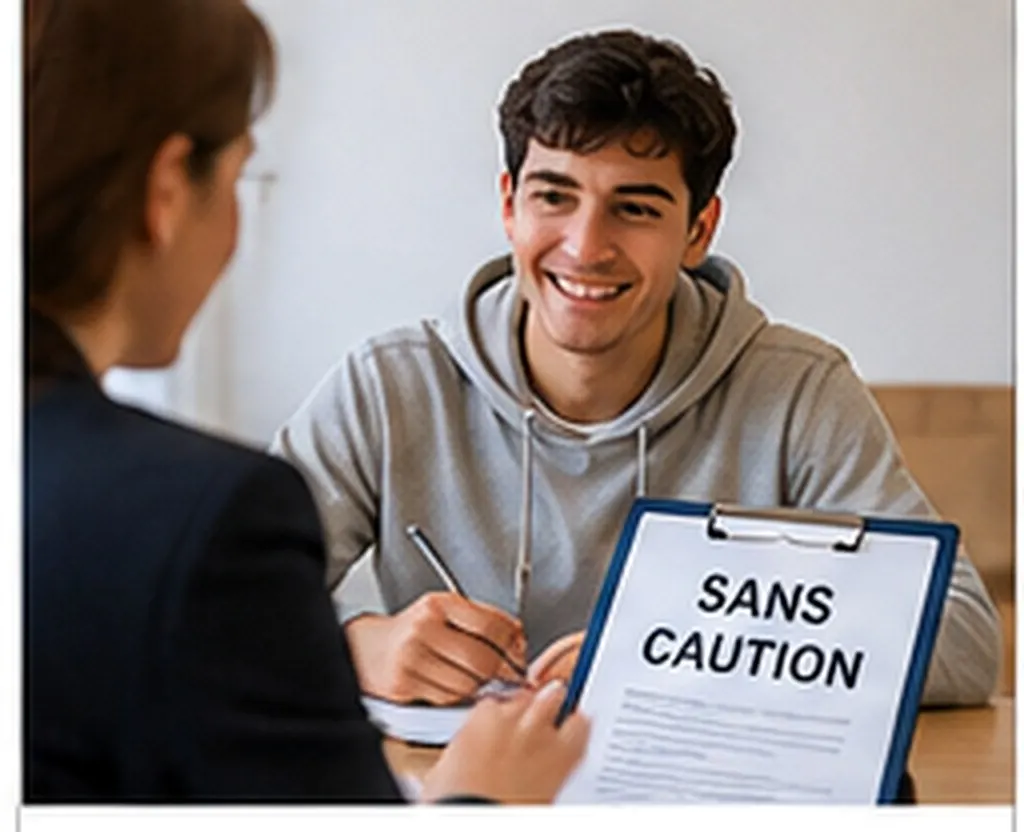
What a surety is, and why banks ask for one
A student loan without surety is a study loan granted without a personal backer committing to repay, so that students with no family able to stand behind them can still obtain funding. A surety (in French, caution) is a person who commits to repay your debt if you do not. For student loans, it is usually a parent, sometimes a grandparent or another relative. Banks ask for it because a student has no income history and little to seize if repayments stop; the surety's salary and assets become the real security.
Not all sureties carry the same weight. Under French law, a simple surety can require the bank to pursue the borrower first. A joint and several surety, the form banks almost always use, can be asked to pay as soon as you miss payments, without the bank having to chase you beforehand. Individuals who give a surety must sign a precise written statement of the amount and duration they commit to, and the bank must inform them each year of what remains due.
That commitment is heavy. A parent who signs may find it harder to borrow for their own needs, and a family conflict or a death does not automatically release the surety. It is no surprise that many students prefer, or need, a student loan without surety.
Who needs a student loan without surety
- students whose parents have modest or irregular income, or are retired, unemployed or self-employed;
- students estranged from their family or under the care of child-welfare services in the past;
- students whose parents live abroad and have no assets or income the bank can assess;
- students who simply do not want a parent to carry the risk;
- adult learners returning to education without anyone in a position to guarantee them.
The situation overlaps with the absence of a parental guarantor, covered on our flagship page, where the student loan without a parental guarantor route is set out step by step. Here we focus on the legal surety and every substitute for it.
The State guarantee: France's surety-free student loan
France's main answer is the student loan guaranteed by the State, distributed by partner banks with Bpifrance covering a large share of the loss if a borrower defaults. The bank then requires neither a personal surety nor an income condition. The scheme is open to French students and to EU or EEA nationals studying in France, within an age limit, and the money can be used for tuition, housing or living costs. Repayment can be deferred during studies.
Two practical points matter. First, the guarantee does not oblige the bank to lend; each network has a limited allocation and its own assessment, so try several banks if the first refuses. Second, the State guarantee is not free money: you still repay in full, and in case of default the bank and then the State recover the debt. See our dedicated guide to the government guaranteed student loan for eligibility and application steps.
If repayments become difficult
Contact the bank as soon as you see a problem coming. Before the guarantee is called, lenders can often extend the term, adjust the deferral or reschedule missed instalments. Once the loan is declared in default, recovery becomes formal and much harder to negotiate. Because no relative is involved, the consequences fall on you alone, including possible registration in the national file of credit repayment incidents, which can block other borrowing for years.
Other substitutes banks may accept
| Substitute | How it works | Cost to you | Main limit |
|---|---|---|---|
| State guarantee (Bpifrance) | Public fund covers most of the bank's loss | Usually included in the loan conditions | Age, nationality, bank allocations |
| Guarantee company | A specialised body acts as surety in exchange for a fee | One-off fee or contribution, sometimes partly refundable | Rarely offered for student credit |
| Pledged savings | Savings or a life-insurance policy are blocked as security | Lost return on the blocked money | You or your family must have savings |
| Co-borrower | A second person signs as borrower, not as surety | No fee, but shared liability | The co-borrower is fully liable from day one |
| Borrower insurance | Covers death and disability, not inability to pay | Monthly premium | Does not replace a surety on its own |
Guarantee companies
For home loans, French banks routinely use mutual guarantee companies instead of mortgages. For student credit this practice is less common, but some banks and student-focused lenders work with a guarantee body. Ask how the fee is calculated and whether part is refunded at the end.
Pledged savings
If you have savings of your own, perhaps from an inheritance or a family gift, the bank may accept them as security. It is a strange-looking arrangement, since you borrow while holding money, but it can make sense when the savings are locked in a long-term product you do not want to close.
Co-borrower versus surety
A co-borrower is not a surety under another name. They sign the loan as a debtor and owe the full amount from the outset. Choose this only with someone who fully understands the commitment.
Funding that never requires a surety
- Grants and scholarships, which are never repaid.
- Honour loans from associations, foundations and some schools, interest-free and granted on the strength of your project; read the guide to the student honour loan.
- Public student loans abroad. In the United Kingdom, government loans for tuition and maintenance require no guarantor and are repaid as a share of income above a threshold. Undergraduates in the US can take federal Direct Loans with no co-signer and no credit check. Canada Student Loans, Australia's HELP, Sweden's CSN, Norway's Lånekassen and the Netherlands' DUO all lend to students on public terms without a family surety.
- Employer funding for apprentices and work-study students, whose tuition is often paid by the company.
Private loans in those countries, by contrast, frequently require a co-signer, so the public route should always be exhausted first.
Illustrative example: three routes for the same loan
Illustrative example. Amine, 22, a French national, needs €10,000 for a master's year. His mother is retired on a small pension and cannot act as surety.
- State-guaranteed loan. His first bank has used its allocation for the year; the second agrees. No surety, no income condition, repayment deferred for 12 months.
- Pledged savings. Had the State route failed, his bank would have lent €10,000 if €3,000 held in his life-insurance policy was pledged, leaving €7,000 of the risk uncovered, which the bank accepted given his course.
- Guarantee company. A third lender proposed a guarantee body charging, in this illustration, 1.5% of the capital as a one-off fee: €10,000 × 1.5% = €150, added to the cost of the loan.
Amine chooses the first route because it costs nothing extra and leaves his savings untouched. The example shows why trying several banks is worth the effort.
Preparing a strong application for a student loan without surety
Without a surety, the bank's decision rests on you. Strengthen the file with:
- proof of admission and the programme's employment record;
- a simple budget showing how the money will be used and why the amount is needed;
- evidence of regular income, even small, such as a part-time job;
- a clean banking record, with no unauthorised overdrafts in recent months;
- details of grants obtained, which show the loan is only part of the funding.
Consider borrower insurance carefully: it protects your family in case of death or serious disability, and the bank may require it. The guide to student loan insurance explains how to compare cover.
Traps when you have no surety
- "No guarantee needed" offers online. Lenders promising a large student loan without surety, without checks, in exchange for an upfront fee are scams.
- High-cost credit as a substitute. Revolving credit and payday-style loans need no surety because they charge for the risk through very high rates.
- Informal sureties. A friend who agrees to "help if needed" is not a legal surety and will not satisfy a bank; and a friend who signs formally takes on a serious liability.
- Signing under pressure. Never sign as co-borrower for a partner's loan, or ask someone to do so for you, without reading the contract together.
A student loan without surety is entirely realistic in France and in most countries with public student finance. The key is to start with the State-backed and public options, then turn to private substitutes only for what remains.
Frequently asked questions
What is the difference between a surety and a guarantor?
In everyday English the words are often used interchangeably. Legally, a surety is a person who commits to pay a debt if the borrower fails, which is what French banks call a caution. A guarantor can also be an institution, such as the State or a guarantee company. Either way, the commitment is binding and long-lasting.
Can I get a student loan without surety in France?
Yes. The State-guaranteed student loan offered by partner banks requires no personal surety and no income condition for eligible French and EU or EEA students. Banks still assess each application and have limited allocations, so apply to several networks. Honour loans and grants are other surety-free sources worth combining with it.
Does borrower insurance replace a surety?
No. Borrower insurance pays the bank if you die or become seriously disabled, and sometimes in case of incapacity to work. It does not cover simply being unable to pay because of low income. Banks may ask for both, but insurance alone rarely persuades a lender to drop its request for a surety.
Is a co-borrower better than a surety?
Not necessarily. A co-borrower owes the debt from the start and shares the loan fully, while a surety is called upon only if you default. For the person helping you, a co-borrower commitment is often heavier. It suits couples or partners with shared finances, less so a relative who simply wants to help.
Can international students borrow without a surety?
Non-EU students in France are generally excluded from the State-guaranteed loan, so French banks usually ask them for a local surety. Options include loans from their home country, scholarships from their government or the host institution, and international lenders working with certain universities. EU and EEA students can use the State scheme like French nationals.